Overview
At a glance
Is this game right for my group?
ABG editorial scores on a 1–5 scale.
Harder to teach
High replayability
Highly interactive
Scales well
Deep strategy
How it plays
How does it play?
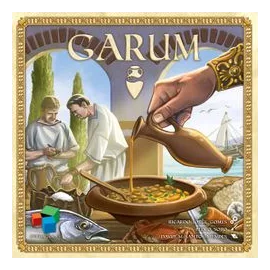
Garum was a fermented fish sauce used as a condiment in the old ages; its manufacture and export was an element of prosperity and perhaps an impetus for the Roman penetration of Lusitanian and Hispanian coastal regions.
Core mechanisms
Key systems that shape the decisions players make.
Area Majority
Compete to have the strongest presence in areas that award control or points.
Modular Board
Build the play area from interchangeable sections that vary between games.
Hand Management
Time and sequence a limited hand of cards to preserve future options.
Pattern Building
Place elements to create arrangements that satisfy scoring or action patterns.
Tile Placement
Place tiles to build a shared or personal spatial arrangement.
Worker Placement
Commit limited workers to action spaces before opponents occupy them.
Read the full game description
Garum was a fermented fish sauce used as a condiment in the old ages; its manufacture and export was an element of prosperity and perhaps an impetus for the Roman penetration of Lusitanian and Hispanian coastal regions. Garum from today’s Portugal and Spain was highly prized in Rome and has now inpired a versatile strategy boardgame for the whole family, ages 8 and up, that plays 2 to 4 players. Garum is a tile-laying game, which plays in about 30 minutes, it is language independent and features endless replayability, due to its board system, that ensures no two games are alike. In Garum, each player represents a master in the preparation of a specific type of fish sauce and receives a set of 16 Cetarian Tiles; each one has 4 spaces filled by 4 colors in different proportions, though the color that the player is defending is the predominant one. The goal of the game is to play Cetarian Tiles strategically, in order to get a huge number of his own colour symbols in selected rows or columns - the greater the influence, the higher the reward! While placing the tiles, players may apply to score, collect some bonuses and also block their opponent’s intents. Whoever scores most points is the winner. -description from designer