Overview
At a glance
Is this game right for my group?
ABG editorial scores on a 1–5 scale.
Harder to teach
High replayability
Highly interactive
Scales well
Deep strategy
How it plays
How does it play?
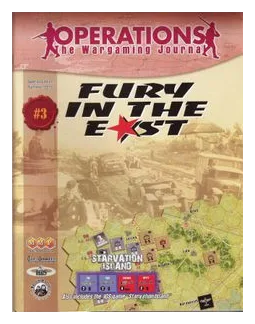
Fury in the East is a wargame on the first nine months of the great Russo-German War (per MMP). The game is designed by accomplished Japanese designer, Ginichiro Suzuki and originally appeared as G-Barbarossa.
Core mechanisms
Key systems that shape the decisions players make.
Dice Rolling
Roll dice to introduce uncertainty into actions, production, movement, or resolution.
Combat Results Table
Compare opposing strength as a ratio, then consult a table to resolve combat.
Hexagon Grid
Use a hexagonal map where each space connects evenly in six directions.
Simulation
Model a real or imagined system through detailed cause-and-effect rules.
Read the full game description
Fury in the East is a wargame on the first nine months of the great Russo-German War (per MMP). The game is designed by accomplished Japanese designer, Ginichiro Suzuki and originally appeared as G-Barbarossa. Fury in the East includes 262 counters and a 22"x34" map (56cm x 86cm) and is included in Operations Special Magazine #3. The game features an unusual mechanism for the Soviet combat units and generals. When generals are involved in combat for the first time their counters are flipped and their true capabilities revealed. When combat units suffer a step loss, their previously unknown weakened capability is revealed.