Overview
At a glance
Is this game right for my group?
ABG editorial scores on a 1–5 scale.
Harder to teach
High replayability
Highly interactive
Scales well
Deep strategy
How it plays
How does it play?
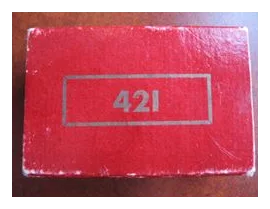
This game is popular in Europe. It is played with three dice and an number of tokens ("fiches", usually 11 or 21) and it is not uncommon to find special porcelain boxes, marked with the dice numbers 4-2-1.
Core mechanisms
Key systems that shape the decisions players make.
Read the full game description
This game is popular in Europe. It is played with three dice and an number of tokens ("fiches", usually 11 or 21) and it is not uncommon to find special porcelain boxes, marked with the dice numbers 4-2-1. Play is in two phases. "Charge" and "Décharge" (discharge). Charge phase : all players roll the dice once and only once, each. The biggest hand takes as many tokens as the value in points of his or her hand. This process is repeated until all tokens have been distributed (with the last hand taking has many tokens as are available). If a player has all tokens at the end of the charge, the game is finished (and he or she pays a round of drinks). Discharge phase : The player with the biggest number of tokens has the first roll and then clockwise. The first player of a round of rolls decide for one or two rerolls. A reroll meaning rerolling one, two or all dice, to try to achieve the best hand. By electing to have rerolls, he or she allows the same number of rerolls to the other players. The one who rolls the biggest hand gives a number of tokens equal to the value of his hand (or all of his tokens if not enough) to the player who rolled the lowest hand. That player becomes first player. The game ends when one player has all tokens. He's the loser of the game and pays the next round. If at some point a player has no tokens, play continues without him/her ("saved"). Hands rank as follows (from biggest to smallest): 1. 421 2. 3 aces (1-1-1) 3. 2 aces-six (1-1-6) 4. 3 six (6-6-6) 5. 2 aces-five (1-1-5) 6. 3 fives (5-5-5) 7. 2 aces-four (1-1-4) 8. 3 fours (4-4-4) 9. 2 aces-three (1-1-3) 10. 3 threes (3-3-3) 11. 2 aces-two (1-1-2) 12. 3 two (2-2-2) 13. 6-5-4 14. 5-4-3 15. 4-3-2 16. 3-2-1 Others hands are by decreasing order of values the dice, from 665 to 221 (which is "nenette"). For info, the last value before 221 is 322. 1-1-x are called "fiches" x-x-x are called "baraques" 6-5-4 and the like are called "tierces" 421 is worth 11 points (sometimes 10 or 8 in variants) 111 is worth 7 points x-x-x is worth x points (except for 111, see above) 1-1-x is also worth x points (except, again, for 111) The difference is that for x, 1-1-x>x-x-x as explained in the order of hands above. Tierces are worth 2 and the rest is worth 1.