Overview
At a glance
Is this game right for my group?
ABG editorial scores on a 1–5 scale.
Harder to teach
High replayability
Highly interactive
Scales well
Deep strategy
How it plays
How does it play?
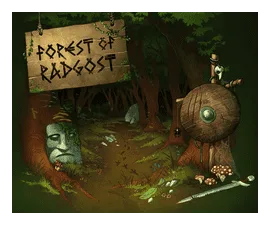
Detailed miniatures, immersive storytelling, and rich mythology await you in Forest of Radgost, a cooperative storytelling tabletop game that brings Slavic mythology to life.
Core mechanisms
Key systems that shape the decisions players make.
Deck Construction
Build a deck before play by selecting cards under defined construction rules.
Cooperative Game
Players coordinate their actions toward a shared objective and win or lose together.
Deck / Bag Building
Add new pieces during play to improve the cards, tokens, or dice drawn later.
Action Timer
Actions become available or resolve according to a timer or countdown.
Different Dice Movement
Different dice govern the movement of different pieces or groups.
Read the full game description
Detailed miniatures, immersive storytelling, and rich mythology await you in Forest of Radgost, a cooperative storytelling tabletop game that brings Slavic mythology to life. When a boy and a girl disappear from their village somewhere in IX century Europe, the village druid dispatches a search party to find the children and escort them back to safety. As one of the members of that search party, you will need to trespass into the sacred forest and cross the boundary that separates the realm of humans from the realm of the Slavic deity Radgost. Inhabiting the forest are strange beings such as the Psoglav, Lesnik, or Todorci, none of which take kindly to human intruders. You'll need to use all your skills, wisdom, and instincts to survive the numerous encounters with these strange creatures. Along the way you will develop your character, collect items, gain skills, separate and rejoin with other members of the search party, and, possibly, discover the secret reason why the druid chose you to join the search party. Forest of Radgost is a role-playing game where each player controls a character with a fleshed-out backstory, motivation, and skill-set. Players navigate the web of interconnected forest footpaths with a pair of dice that determine the distance and direction of their movement, evoking the feeling of being lost in the woods, with creatures lurking at each crossroad. At each encounter, players must decide whether to run, hide, flee, or communicate, without knowing which creature they are about to face. Depending on their choices, the encounters are resolved according to the numerous scenarios provided in the accompanying book of encounters. Nine decks of cards add an open-world dimension, allowing players to explore the rich game world based on four years of research into Slavic mythology. Numerous scenarios, map details, and cards interact to weave a unique storyline ensuring that players will never have the same adventure twice. —description from the designer