Overview
At a glance
Is this game right for my group?
ABG editorial scores on a 1–5 scale.
Harder to teach
High replayability
Highly interactive
Scales well
Deep strategy
How it plays
How does it play?
Football Strategy boils the sport down to play calling skill.
Core mechanisms
Key systems that shape the decisions players make.
Paper-and-Pencil
Record choices and results directly on a personal sheet.
Dice Rolling
Roll dice to introduce uncertainty into actions, production, movement, or resolution.
Memory
Remember previously revealed information, positions, or sequences.
Rock-Paper-Scissors
Resolve choices through a circular set of strengths and weaknesses.
Simulation
Model a real or imagined system through detailed cause-and-effect rules.
Read the full game description
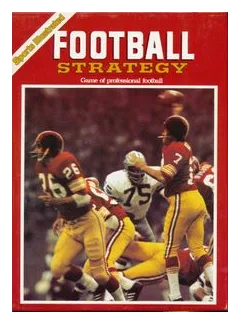
Football Strategy boils the sport down to play calling skill. The game's structure is simple: The defensive player selects one of 10 formation cards (ranging from an 8-man line "goal line stand" to a pass prevent defense with five safeties); the offensive player calls a play (a choice of 20, plus punting). Cross-indexing the choices on a matrix shows what happened. Except for "long gains", the outcome of each play against each defense is always the same. Dice are rolled only to determine the distance of long gains and the results of kickoffs and field goal attempts. Each play consumes a prescribed number of seconds, from 15 to 45. The players mark off the time and play four quarters, following the standard football rules. For variety, three types of offense ("pro style", "aerial game" and "ball control") are available, each with a different, though not radically different, results matrix. Simple though it is, the game is engrossing (see the "More Information" screen), and play generally follows realistic patterns, though the handling of punts and on-side kicks (both more effective than in real life) is questionable. Also, because the design changed little after its debut in 1959, the plays and defenses don't reflect the state of the art in contemporary professional football. This is the era of Otto Graham, not Eli Manning. For those who are so inclined, Football Strategy lends itself to mathematical analysis. Many years ago, an entrant into the tournament at Origins went to the trouble of using game theory to generate charts showing the optimal mix of plays in different situations. He reached the finals but, in a victory for human intuition over number crunching, lost the championship game by a touchdown and a field goal.