Overview
At a glance
Is this game right for my group?
ABG editorial scores on a 1–5 scale.
Harder to teach
High replayability
Highly interactive
Scales well
Deep strategy
How it plays
How does it play?
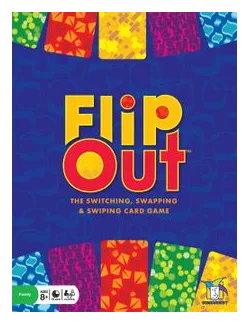
In FlipOut – originally published as Patchwork – players trade colorful, two-sided cards between wood racks to create sets or steal them from each other.
Core mechanisms
Key systems that shape the decisions players make.
Pattern Recognition
Identify recurring visual, spatial, or logical arrangements.
Hand Management
Time and sequence a limited hand of cards to preserve future options.
Set Collection
Gather related items that become more valuable when scored together.
Trading
Exchange resources, assets, or promises with other players.
Memory
Remember previously revealed information, positions, or sequences.
Read the full game description
In FlipOut – originally published as Patchwork – players trade colorful, two-sided cards between wood racks to create sets or steal them from each other. Each player starts the game by drawing cards from the deck and filling their racks, with the hidden side of a card being seen only by its owner. On a turn, a player takes two actions from six possible actions, repeating actions, if desired: • Flip any card in a rack so the front is now the back. • Switch the position of two cards in any player's rack. • Swap one card between your rack and an opponent's, keeping the cards facing the same way at all times. • Swap two adjacent same-colored cards as above. • Score a set of 4-6 adjacent same-colored cards on your rack; place the cards in a scoring pile of your own, then refill your rack to six cards. • Score a set of 4-6 adjacent same-colored cards on an opponent's rack, giving that player one of the cards to score. That player then refills her rack. The game ends when a player can't refill her rack. The player who collected the most cards wins.