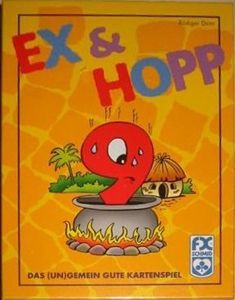
Table feel
ex & hopp has a high level of direct confrontation and strategic depth in confrontation. Players need to frequently pay attention to and react to others' strategies and turns. However, the game does not emphasize cooperation as much.
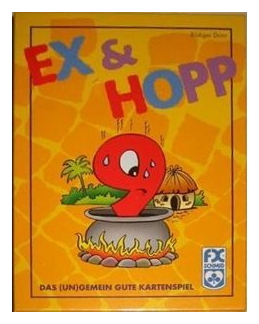
A quick and simple card game for 2-6 milk-drinking players. Each player places a color card down as their marker and the matching sets of cards numbered 1-12 in those colors make up the deck. The deck is shuffled and players get 4 cards, the remainder goes down as a draw deck. Th...
Players
2-6
Play time
Not listed
Age
10+
Complexity
1.17/5
Rating
5.45
Group fit
ABG editorial scores on a 1–5 scale.
Harder to teach
High replayability
Highly interactive
Scales well
Deep strategy
Luck-sensitive
ex & hopp has a high level of direct confrontation and strategic depth in confrontation. Players need to frequently pay attention to and react to others' strategies and turns. However, the game does not emphasize cooperation as much.
ex & hopp has a high replayability score due to its high variability gameboard, impactful expansions, deep strategic possibilities, and good scalability. The game offers fresh experiences each time it is played and allows players to improve their strategies over time. The player interaction score is average, and the game adapts well to different player counts. While it may take some time to learn, it offers a good balance between easiness and depth.
Ex & Hopp has a moderate influence of luck. Random elements have a notable but not exclusive impact on the game outcome. Players have substantial ability to mitigate randomness through strategic decisions and planning. The game outcome is primarily determined by player strategy and decisions, with luck playing a minor role.
A quick and simple card game for 2-6 milk-drinking players. Each player places a color card down as their marker and the matching sets of cards numbered 1-12 in those colors make up the deck.
A quick and simple card game for 2-6 milk-drinking players. Each player places a color card down as their marker and the matching sets of cards numbered 1-12 in those colors make up the deck. The deck is shuffled and players get 4 cards, the remainder goes down as a draw deck. There is a set of small tiles in red and black for negative or positive points (red are 4,4,5,5,6,6, black are 2,3,3,4,4,4,5,5,5,6,6,6). These are shuffled face down and 4 turned up to start 4 rows. On your turn, you can place a card against a row or try to swap a card with another player. If you want to swap, you simply offer a color for another color, mentioning no numbers. Swap with the player of your choice, but if nobody wants to swap, you've wasted your turn. When you play a card to a row, you draw back so you have 4 cards. When the row is full, determined by the number on the tile, the player with the highest total in the cards has to take the tile, be it positive or negative. Usually your choices are obvious, but sometimes it is worth assisting another player to take a row, rather than waste a good card for you on a low or negative tile. If a row is tied between players, the cards are discarded and the tile stays for more cards. The discard deck is shuffled over, taken tiles refreshed by new ones. The game ends when the tiles are all taken, deduct the negative from the positive to get your score. This game was re-themed and expanded on with Relikt.
Shopping
No verified retailer offers are available yet. The references below may still help you continue your search.
No verified prices are available yet.
Box art, components, and other visual details from the game.
Language and publisher variants currently recorded in the catalog.
| Edition | Year | Language | Publisher / Region |
|---|---|---|---|
| No editions imported yet. | |||
Rulebooks, player aids, FAQs, and solo resources.
No files imported yet.
No published linked games yet.