Overview
At a glance
Is this game right for my group?
ABG editorial scores on a 1–5 scale.
Harder to teach
High replayability
Highly interactive
Scales well
Deep strategy
How it plays
How does it play?
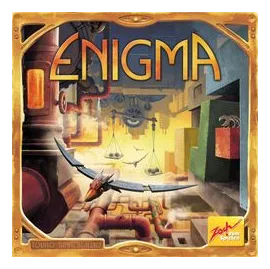
In Enigma, players are exploring an ancient temple, solving different problems to make their way from room to room.
Core mechanisms
Key systems that shape the decisions players make.
Read the full game description
In Enigma, players are exploring an ancient temple, solving different problems to make their way from room to room. Problem solving is done simultaneously in four different categories — tangrams, block-stacking, canal-building and balance problems — and those who succeed expand the temple with the problem tile they solved, thus adding a new chain of rooms inside the temple or extending an existing chain of rooms. After placing a tile, a player can occupy a room on that tile with one of his three archeologists as long as no other room of the same color is already occupied in that chain. When the chain is closed — that is, when the chain has no "loose ends" that can be expanded upon — any archeologists in that chain's room return to their players, and players score 1 point for each archeologist they receive. The game ends when somebody reaches 15 points, and the player who has the most points wins.