Overview
At a glance
Is this game right for my group?
ABG editorial scores on a 1–5 scale.
Harder to teach
High replayability
Highly interactive
Scales well
Deep strategy
How it plays
How does it play?
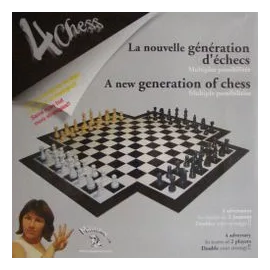
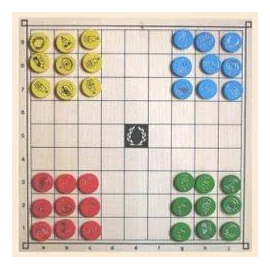
Djambi, or Chess of Machiavelli is a game for 4 players that can be played with only 3. There also exists a 5-player version called Pentachiavel.
Core mechanisms
Key systems that shape the decisions players make.
Grid Movement
Move pieces between adjacent spaces on a regular grid.
Pattern Movement
Pieces move according to defined geometric patterns.
Static Capture
Capture opposing pieces through fixed positional relationships.
Square Grid
Use an orthogonal grid where position and adjacent spaces shape movement or placement.
Read the full game description
Djambi, or Chess of Machiavelli is a game for 4 players that can be played with only 3. There also exists a 5-player version called Pentachiavel. It is a game of treason. Each player is the leader of a political party composed of 9 pieces: 1 Leader 1 Journalist 1 Assassin 1 Provoker 1 Necromobile 4 Activists who roam a 9x9square board where all squares are the same except the central one, called The Labyrinth. All counters move as the Queen in Chess, except the Activist who moves the same but only for two squares. A piece cannot move through another piece, whether alive or dead. Object of the game: gaining absolute power, that is killing all other leaders. "To do this, all players have the weapons of the actual politics: manipulation, provocation, activism, recuperation, scandal and political crime. The course to power is not a gala dinner, so all pieces can be physically eliminated. In politics, a dead is as encumbrant as a living person, so all dead pieces are kept on the board, face down." Dead pieces have no color. The Labyrinth is the basement of the Legal Power, the road to Absolute Power. Only a Leader may stay on this square. It makes its parti play after each opponent. But there, it can be killed by nearly all other pieces. The Leader: can kill any piece on the board by taking its place. The taken piece is placed on any other adjacent free square of the board, dead. The Journalist kills a piece that is adjacent to any one of the 4 squares that share a common border with its square. It does this just after having moved. The body lies dead where it was killed. He must move at least one square before killing. The Assassin, can kill any piece by taking its place. The piece is placed, dead on the place the Assassin was before moving. The Provoker, mover of the living: can move any living piece if it takes its position. The taken piece is placed on any other free square of the board, alive. The Necromobile, mover of the dead: can move any dead piece if it takes its position. The taken piece is placed on any other free square of the board, dead. The Activists can kill a piece by taking its place. The taken piece is placed on any other free square of the board, dead. They CAN'T kill a leader in The Labyrinth. These are most of the rules. You can find the rest (in French, sorry) at the link below.