Overview
At a glance
Is this game right for my group?
ABG editorial scores on a 1–5 scale.
Harder to teach
High replayability
Highly interactive
Scales well
Deep strategy
How it plays
How does it play?
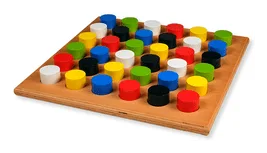
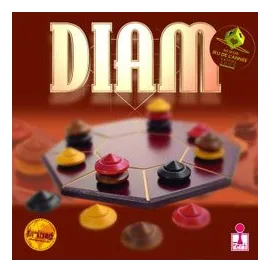
[translated from the box] Diam is a game of strategy for 2, 3, or 4 players. The simplicity of the rules and the depth of play will satisfy players of all strengths and all ages.
Read the full game description
[translated from the box] Diam is a game of strategy for 2, 3, or 4 players. The simplicity of the rules and the depth of play will satisfy players of all strengths and all ages. The goal of the game: to place 2 pawns of identical color at the same height on 2 diametrically opposed spaces. The objective is very clear, and you constantly feel you're close to winning. Victory is within your grasp! But beware, this simplicity is misleading. With each move, your opponent can discern your intentions and launch a counter-attack! You'll need solid nerves. Stay focused, anticipate, move your colors with accuracy and you will become the master of Diam! How to play? In the beginning, each player has a reserve of 8 pawns: 4 red pawns and 4 orange pawns for player 1: 4 maroon pawns and 4 black pawns for player 2. In a turn, each player can: either place a pawn from the player's reserve onto an empty space or onto a pawn already on the board, or move one of the player's pawns already placed on the board to an adjacent space. With 3 players: This alternative is played has 2 against 1. The basic rules are identical to the rules for 4 players; the player who is alone having 2 colors, however. With 4 players: This alternative is played by teams of 2. Each player has his own color and the players play in turn. The basic rules are identical to the rules for 2 players, the following constraint is added: a player cannot place a pawn from his partner's reserve. a player can, on the other hand, move his pawns or his partner's pawns already on the board. A winner of the 1998 Concours International de Créateurs de Jeux de Société.