Overview
At a glance
Is this game right for my group?
ABG editorial scores on a 1–5 scale.
Harder to teach
High replayability
Highly interactive
Scales well
Deep strategy
How it plays
How does it play?
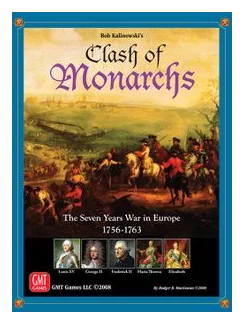
The Seven Years War In Europe, 1756-1763 Clash of Monarchs lets two to four players recreate the titantic struggle that raged across Europe and the world, pitting Frederick the Great’s Prussia and its Hanoverian allies against Maria Theresa’s Coalition of Austrian, French, Russian, Saxon, Swedish, and Holy Roman Empire forces. Each player directs the effort of one or more of the major powers, plus their minor allies, using the card-driven operations and point-to-point movement system of many of GMT’s most highly-regarded games.
Core mechanisms
Key systems that shape the decisions players make.
Read the full game description
The Seven Years War In Europe, 1756-1763 Clash of Monarchs lets two to four players recreate the titantic struggle that raged across Europe and the world, pitting Frederick the Great’s Prussia and its Hanoverian allies against Maria Theresa’s Coalition of Austrian, French, Russian, Saxon, Swedish, and Holy Roman Empire forces. Each player directs the effort of one or more of the major powers, plus their minor allies, using the card-driven operations and point-to-point movement system of many of GMT’s most highly-regarded games. The cards help players enact Frederick’s pre-war invasion planning, Austrian minister Kaunitz’s diplomatic triumph in the 2nd Treaty of Versailles, the operational ascendancy of Prussian and Hanoverian light troops, formation of the Austrian General Staff, huge financial loans, court intrigue at Versailles, Vienna, and St. Petersburg, and dozens of other key political, economic, and military events. COM also uses split decks, which foster play of each power’s events in two phases -- Early War (usually through mid-1758), and Wider War (1758 to conclusion) – and allow a multi-player game to use exactly the same rules as a 2-player contest. COM augments the CDG system with a Colonial Conflict sub-game, a fully-integrated treatment of light unit operations, and a Fortunes of War chit pull, which varies the occurrence and/or timing of events beyond players’ control each year -- severe weather, desertion, attrition, possible deaths of English king George II, Empress Elizabeth of Russia, et al, and Madame Pompadour’s political influence over the French commanders, to add further uncertainty and drama to the campaigns.