Overview
At a glance
Is this game right for my group?
ABG editorial scores on a 1–5 scale.
Harder to teach
High replayability
Highly interactive
Scales well
Deep strategy
How it plays
How does it play?
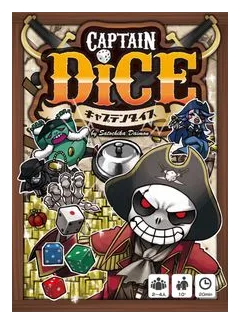
User summary Captain Dice (????????) is a dice and action card game, combining speed and cunning. Swiftly place dice to secure treasure cards.
Core mechanisms
Key systems that shape the decisions players make.
Area Majority
Compete to have the strongest presence in areas that award control or points.
Action Queue
Place actions into an ordered queue that resolves now or on later turns.
Dice Rolling
Roll dice to introduce uncertainty into actions, production, movement, or resolution.
Hand Management
Time and sequence a limited hand of cards to preserve future options.
Read the full game description
User summary Captain Dice (????????) is a dice and action card game, combining speed and cunning. Swiftly place dice to secure treasure cards. Then replace your dice with action cards to attack the other players. Then collect treasure if your cards survive the attacks. The playing area is a grid of treasure cards and a bell in the centre. The bell is rung, and each player rolls and rerolls their own six dice entirely at will, trying to make combos to place on treasure cards. As soon as there are any three pairs in any line, any player may ring the bell to force a stop (and becomes the start player). It helps to secure treasure cards in sections; if you succeed, you collect all treasures you have linked up. Each player has nine cards, numbered 0 to 5 (four 5 cards each). Each card attacks neighbouring locations in different directions, except the 0 card which is a shield, and the 5 cards on which you are becalmed. Depending on which locations you grabbed, you take turns placing cards face down, taking back your dice. The actions are revealed and resolved, going from 0 to 5 (tied numbers are won closest to the start player). Here the tactical element appears. The cards 1 to 4 attack each other in set patterns, and in rank order from low to high. Since you cannot pick up cards spent in previous rounds until you clear your hand, you must choose carefully which cards you place where. If you think a spot is safe from any attack, you can safely spend a 5 card and help clear your hand. If you think a spot is certain to be attacked, place your 0 and it survives. If you have claimed places on straight lines, you'll collect all the empty treasure cards lying between them, so often you want to be secure. If you know what cards the others have spent, you might get your attack in first with a low numbered attack. After a couple of rounds, the tactical choices become very clear and frustrating. Using the wrong action cards is a costly waste. Failing to get dice down means you get fewer chances to collect treasure and it takes longer to clear your hand and pick up your discard. Once the action cards have been resolved, any left standing take the treasure cards below them or linked in straight lines, and the action cards go to a personal discard face-down. Empty treasure spots are refilled, and the bell is rung! The game ends when there is not enough treasure on the table. At the finish, most treasure cards wins. The game is fast and the theme fits the game play. The game is language free. The second edition simply revised the artwork on the box and cards to a more cartoon/manga style and added a strategic variant. Otherwise, components and gameplay are identical between the first and second editions. Publisher's summary Roll the dice to your heart’s content! Ring up a storm with the bells! Speed and strategies are both important for this analog game, which offers real-time domination + mind games, appealing to all 5 senses. Secure territories pre-emptively by placing a pair of dice on the treasure cards as fast as possible, then take time to think about how to protect the territories with attack cards, so that other players cannot foil your plans. If you are successful in holding your territory on the treasure cards, then SUCCESS! The treasure cards are rewarded to you and the process is repeated again. In the end, the player with the most treasure cards wins. ??????????????????? ????????????????????????×????????????????????? ??????????????? ??????????????????????????????????????????????????????????????????????????????? ??????????????GET?????????????? ????????????????????????????????????