Overview
At a glance
Is this game right for my group?
ABG editorial scores on a 1–5 scale.
Harder to teach
High replayability
Highly interactive
Scales well
Deep strategy
How it plays
How does it play?
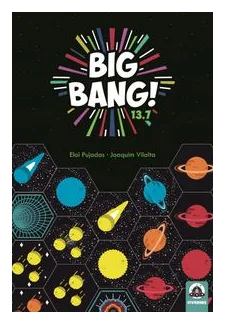
In Big Bang 13.7, you become one of the universe's creators, playing with celestial bodies such as colored planets, stars, asteroids, comets, and astronomic phenomena such as supernovas, wormholes and superdestructive black holes.
Core mechanisms
Key systems that shape the decisions players make.
Pattern Building
Place elements to create arrangements that satisfy scoring or action patterns.
Tile Placement
Place tiles to build a shared or personal spatial arrangement.
Team-Based Game
Players compete in fixed teams and coordinate toward a shared team result.
Turn Order: Time Track
Determine or change the order in which players take their turns.
Read the full game description
In Big Bang 13.7, you become one of the universe's creators, playing with celestial bodies such as colored planets, stars, asteroids, comets, and astronomic phenomena such as supernovas, wormholes and superdestructive black holes. While the universe expands, you can also cause orbits, eclipses, hyperspace, or even the mysterious and almost unknown dark energy. Your goal? Align celestial bodies while a cosmic clock is ticking the passing of time…in millions of years! In more detail, the game is composed by hexagonal pieces: 48 celestial bodies of four types (planets, stars, asteroids and comets), with four colors (yellow, orange, red and blue) and three backgrounds (empty space, stars and galaxy). There are astronomical phenomena pieces (supernova, black hole and wormholes) and special actions (orbit, eclipse, hyperspace and dark energy). Finally, a cosmic clock will tick the passing of time and players' turn. Before the game starts, each player takes two hidden objective cards: a celestial body type and a color. During the game, the player scores victory points by aligning three or more celestial bodies consecutively of their own type or color. The game starts at moment zero of the universe 13.7 billion years ago, with someone placing the first piece: the Big Bang! On a turn, the player has to place one of the four available pieces below the cosmic clock. Two rules are mandatory to place a piece in the universe: The piece must be adjacent to at least two pieces and at least one of them has to be a celestial body. The celestial body has to have a common characteristic with all the adjacent celestial bodies: same type, same color, or same background. Once the game runs out of available pieces and all of them are placed in the universe, the game ends. The players reveal their objective cards and count their victory points based on the alignments according to their two objective cards. Whoever has the most points wins. In case of a tie, the player who is the most behind on the cosmic clock — that is, the one who has invested fewer millions of years — wins.