Table feel
The Battle of the Little Big Horn has a high level of direct confrontation and strategic depth. Players frequently need to be aware of and react to each other's strategies. However, there is less emphasis on cooperation in the game.
The Sioux and Cheyenne Indians were increasingly hostile to the prospectors pouring across North and South Dakota. Chief Sitting Bull gathered a force, by the Little Big Horn river, just north of the Montana-Wyoming border, ready to strike. Three columns of US Cavalry were dispat...
Players
2
Time
?-?
Age
8+
Weight
1.18
Rating
6.00
Should this hit the table?
The Battle of the Little Big Horn has a high level of direct confrontation and strategic depth. Players frequently need to be aware of and react to each other's strategies. However, there is less emphasis on cooperation in the game.
Teaching signal
High replayability
Highly interactive
Scales well
Deep strategy
Luck-sensitive
The Battle of the Little Big Horn has a high level of direct confrontation and strategic depth. Players frequently need to be aware of and react to each other's strategies. However, there is less emphasis on cooperation in the game.
The Battle of the Little Big Horn has a high replayability score due to its high variability, strategic depth, and scalability. The game offers different experiences each time it is played, with multiple paths to victory and variable setups. The presence of expansions adds new content and gameplay elements, enhancing the replay value. Players have room to improve their strategy over time, discovering new tactics and strategies. The game adapts well to different player counts without compromising its appeal or balance. While it may take some time to learn, the depth it offers makes it worth the effort.
The Battle of the Little Big Horn has a moderate influence of luck. Random elements, such as dice rolls or card draws, play a notable but not exclusive role in determining the game outcome. However, players have substantial ability to mitigate the effects of randomness through strategic decisions and planning. The game relies on a balanced mix of luck and strategy, with neither element dominating the gameplay.
Overview
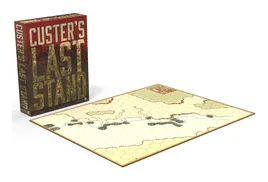
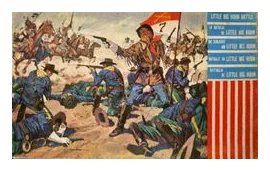
The Sioux and Cheyenne Indians were increasingly hostile to the prospectors pouring across North and South Dakota. Chief Sitting Bull gathered a force, by the Little Big Horn river, just north of the Montana-Wyoming border, ready to strike. Three columns of US Cavalry were dispatched to subdue the Indians. Now you can re-live this historic battle, and you can plan your own strategy. Can you find a way to get Custer, or at least his flag, clear of the battlefield? This game is based on the well known battle of Little Big Horn, where some united Native Americans won against General Custer's 7th cavalry. A simple game combining luck and strategy with different mechanics for different units. Movements and terrain effects are similar to wargames. Horses move faster than foot units and wearing a gun enables some ranged attacks. Winning conditions are different for the 2 opponents: Custer's men can either eliminate all Native American riders or cross the Little Big Horn River and try to reach one of 2 winning spaces on the board, the Native Americans must eliminate general Custer and his 2 officers. It was published by Rojas y Malaret in Spain, as the 3rd game in the GBM series at the end of 1952. The game was licenced and published by Hausser (Germany) in 1963. Later, the Waddingtons (UK) version in 1964 and the Capiépa (France) version in 1965 could be non-authorized versions.
Media
Images, galleries, and videos are grouped here so the page feels visual before every asset is fully hosted.
No media imported yet.
Editions
| Edition | Year | Language | Publisher / Region |
|---|---|---|---|
| No editions imported yet. | |||
Files and documents
No files imported yet.
Commerce mapping
No commerce mappings imported yet.
Credits
Linked items
Related games and expansions help build a connected catalog around every title.
No linked items imported yet.