Overview
At a glance
Is this game right for my group?
ABG editorial scores on a 1–5 scale.
Harder to teach
High replayability
Highly interactive
Scales well
Deep strategy
How it plays
How does it play?
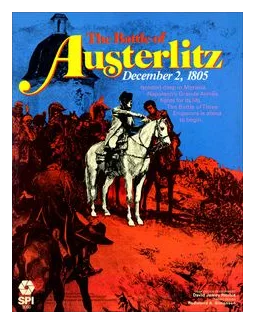
Battle of Austerlitz is a game of the 2 December 1805 conflict was one of the most important and decisive engagements of the Napoleonic Wars.
Core mechanisms
Key systems that shape the decisions players make.
Movement Points
Spend a movement allowance across spaces with different costs.
Dice Rolling
Roll dice to introduce uncertainty into actions, production, movement, or resolution.
Hexagon Grid
Use a hexagonal map where each space connects evenly in six directions.
Combat Results Table
Compare opposing strength as a ratio, then consult a table to resolve combat.
Zone of Control
Restrict or influence movement through areas controlled by nearby pieces.
Read the full game description
Battle of Austerlitz is a game of the 2 December 1805 conflict was one of the most important and decisive engagements of the Napoleonic Wars. In what is widely regarded as the greatest victory achieved by Napoleon and his La Grande Armée of France defeated a larger Russian and Austrian army led by Emperor Alexander I and Holy Roman Emperor Francis II. The battle occurred near the town of Austerlitz in the Austrian Empire (modern-day Slavkov u Brna in the Czech Republic). Austerlitz brought the War of the Third Coalition to a rapid end, with the Treaty of Pressburg signed by the Austrians later in the month.[6] The battle is often cited as a tactical masterpiece The game is relatively small, with an 11" x 17" map and 100 counters. The map scale is 600 yards per hex, and each of the eleven game-turns represents one hour. There are four unit types in Battle of Austerlitz: infantry, artillery, cavalry, and dragoon. The infantry units are mostly divisions. Game Scale: Game Turn: 1 hour Hex: 600 yards / 550 meters Units: Battery to Corps (1 strength point equals approximately 500 men or 5 artillery pieces. Game Inventory: One 11 x 17" four color map One dual-side printed countersheet (100 1/2" counters) One 8-page rulebook One six-sided die Solitaire Playability: High Complexity Level: Medium Players: 2 or more Playing Time: 2-4 hours