Overview
At a glance
Is this game right for my group?
ABG editorial scores on a 1–5 scale.
Harder to teach
High replayability
Low interaction
Scales well
Deep strategy
How it plays
How does it play?
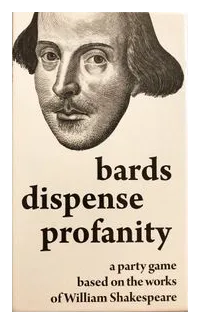
Bards Dispense Profanity is a party game in which you use direct quotations from Shakespeare’s plays to propose answers to mock-serious questions. It’s a hilarious game about playing irreverently with words and meanings.
Core mechanisms
Key systems that shape the decisions players make.
Read the full game description
Bards Dispense Profanity is a party game in which you use direct quotations from Shakespeare’s plays to propose answers to mock-serious questions. It’s a hilarious game about playing irreverently with words and meanings. The game comes with 100 prompt cards and 375 answer cards. In each round, one player serves as a judge and reads aloud a question or fill-in-the-blank prompt. The other players submit answer cards, each containing a verbatim quotation from Shakespeare, as suggested completions for the prompt. The judge reads all the submissions aloud and chooses the best one, construing “best” however he or she sees fit. The winner keeps the prompt card, everybody replenishes their answer cards, and the role of judge rotates to the next player. At the end of the game, whoever has the most prompt cards wins. The game depends on understanding the particular wit of the other players and strategically playing answers to appeal to each round's judge. The sheer linguistic playfulness of Shakespeare’s text is what makes the game exciting and hilarious.