Table feel
Baobab has a high level of direct confrontation and strategic depth in confrontation. Players need to frequently pay attention to and react to others' strategies and turns. However, there is less emphasis on cooperation in the game.
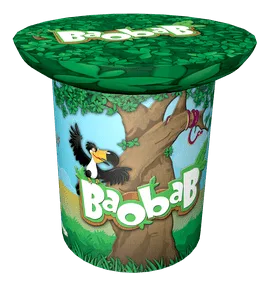
In the dexterity game Baobab, a.k.a. Tumble Tree, players are dealt the 108 cards at random and cannot look at the cards in their deck. The tree trunk — which is the game container in many versions — is placed in the middle of the table with the lid on it. On a turn, a player ann...
Players
2-4
Time
?-?
Age
6+
Weight
1.16
Rating
6.17
Should this hit the table?
Baobab has a high level of direct confrontation and strategic depth in confrontation. Players need to frequently pay attention to and react to others' strategies and turns. However, there is less emphasis on cooperation in the game.
Teaching signal
High replayability
Highly interactive
Scales well
Deep strategy
Luck-sensitive
Baobab has a high level of direct confrontation and strategic depth in confrontation. Players need to frequently pay attention to and react to others' strategies and turns. However, there is less emphasis on cooperation in the game.
Baobab has a high replayability score due to its high variability gameboard, impactful expansions, deep strategic possibilities, and good scalability. It offers a fresh experience each time it is played and allows players to discover new tactics and strategies. The game adapts well to different player counts without compromising its appeal or balance. While it may take some time to learn, the depth it offers makes it worth the effort.
Baobab has a moderate level of luck involved in the game. Random elements like dice rolls or card draws have a notable but not exclusive impact on the game outcome. However, players have substantial ability to mitigate randomness through strategic decisions and planning. The game outcome is primarily determined by player strategy and decisions, with luck playing a minor role.
Overview
In the dexterity game Baobab, a.k.a. Tumble Tree, players are dealt the 108 cards at random and cannot look at the cards in their deck. The tree trunk — which is the game container in many versions — is placed in the middle of the table with the lid on it. On a turn, a player announces that they'll play 1-3 cards, then they turn the cards over from their deck one by one, placing them on the tree as required by what's depicted on the card. If the card shows only foliage, then you can place it anywhere; if it shows a flower or monkey, then you must make the card hang over the edge so that the "ground" depicted on the card has no part of the tree underneath it. The snake must be placed between two other cards, the toucan tossed on top from a foot away, the leopard dropped straight onto the tree from a foot above, and the bat dropped onto the tree — but only after you close your eyes before extending your arm over the table! The beehive card can't be covered by anything except foliage and flowers, while the chameleon copies the card previously played. If any cards fall off the tree while you're adding something to it, then you place those cards (and any cards that you've yet to place that turn) in a personal penalty pile. As soon as someone places their final card, the game ends. Players count the cards remaining in their deck with those in their penalty pile, and whoever has the fewest cards wins!
Media
Images, galleries, and videos are grouped here so the page feels visual before every asset is fully hosted.
Editions
| Edition | Year | Language | Publisher / Region |
|---|---|---|---|
| No editions imported yet. | |||
Files and documents
No files imported yet.
Commerce mapping
Credits
Linked items
Related games and expansions help build a connected catalog around every title.
No linked items imported yet.