Overview
At a glance
Is this game right for my group?
ABG editorial scores on a 1–5 scale.
Harder to teach
High replayability
Highly interactive
Scales well
Deep strategy
How it plays
How does it play?
This is the earliest known racing game that does not use dice for the engine, or even contain any elements of luck (according to Parlett and others). A 2nd edition was never published.
Read the full game description
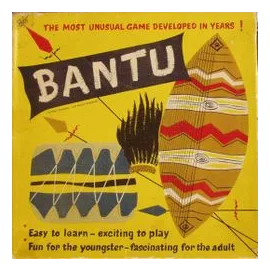
This is the earliest known racing game that does not use dice for the engine, or even contain any elements of luck (according to Parlett and others). A 2nd edition was never published. It was reviewed by Phil Orbanes in Games and Puzzles Magazine #68 under the heading of "Great Games that Never Made It." It has been modified slightly and released as a kit by Paul Jefferies, who renamed it Sack to fit his newly applied theme. In addition to Games and Puzzles #68 (reprinted in Games International (Issue 4 – April 1989)) and Parlett's The Oxford History of Board Games, Bantu has recently been discussed in Abstract Games Magazine. This is a racing game. The track is circular, with four lanes, with some interaction and crossing over between lanes. Each player (2-4) has four pawns numbered 1-4. This number indicates the distance the pawn may move per turn, and where it may be entered onto the board (the fastest pawn (4) must travel the full distance, but each successively slower pawn travels one fourth less distance than its predecessor, so that the (1) pawn travels only one quarter of the board). Pawns may not jump others nor may two pawns occupy the same space. Ending a turn on a space occupied by an opponent's pawn causes the opponent's pawn to be returned to its starting position. Pawns of any ownership that lie on spaces connected by a shaded background add their values together for determining movement. So a (red 1), (blue 4), (green 3) that all lie within the same shaded area would give the first pawn to move, 8 spaces. A player must use all movement without retracing his path on that turn. If the player can not use the entire movement then the pawn can not be moved. If none of his pawns may be moved the entire amount then the player forfeits that turn. First to bear all pawns off wins.