Overview
At a glance
Is this game right for my group?
ABG editorial scores on a 1–5 scale.
Harder to teach
High replayability
Highly interactive
Scales well
Deep strategy
How it plays
How does it play?
“If I have any worth, it is to live my life for God so as to teach these peoples.” - St. Patrick Legend has it that St.
Core mechanisms
Key systems that shape the decisions players make.
Read the full game description
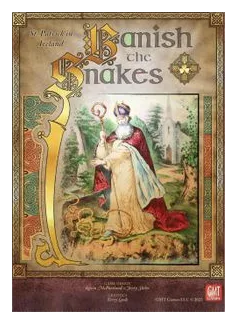
“If I have any worth, it is to live my life for God so as to teach these peoples.” - St. Patrick Legend has it that St. Patrick drove the snakes out of Ireland. True, there are no snakes anywhere on the island- but there have been none since before the last Ice Age! The legend is actually an allegory about his successes in converting Ireland to Christianity. Banish the Snakes is a cooperative game that simulates Ireland in the 5th century, while the Roman Empire was collapsing in the west and Ireland was turning to the Christian religion. Players represent Saints- Patrick and others (up to six of you) who set out to convert the pagans on the island. You must work as a team to convert the people of Ireland before the barbarians completely overwhelm Britain- if you fail, the Irish will not be able to save Civilization in the following centuries! The game board shows a map of Ireland in the 5th century, with four Provinces-the same as today- but no counties yet. Wooden tiles represent the People, Druids, Chiefs, and Kings, and of course the High King at Tara. It is your job to break into the interrelated influences between these groups of people and get your new ideas accepted. Each turn a card is drawn, throwing new challenges at your team. The severity of the event is determined by the previous card, and so no two games can ever play the same. The cards introduce events and ideas of the time, new saints, and historic figures- like Neil of the Nine Hostages. There is a diagram of Great Britain to keep track of the steady decline of Roman civilization in Great Britain. As different parts of Britain succumb to the barbarians, more and more difficult challenges are added to the deck, until finally Britain is completely overwhelmed, cutting off Ireland from the continent and ending the game. If you succeed in your endeavor, Christianity will thrive in Ireland, while paganism overruns Western Europe. The arts, writing, literature and history will flourish on the Emerald Isle! Soon, Irish missionaries will bring these civilizing attributes back to Great Britain and mainland Europe- as Thomas Cahill says in his book, the Irish will save Civilization. But if you fail… —description from the publisher