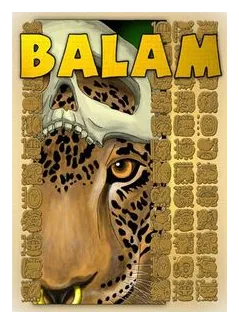
Table feel
Balam has a high level of direct confrontation and strategic depth in confrontation. Players must frequently pay attention to and react to each other's strategies and turns. However, there is less emphasis on cooperation in the game.
The boards represents various sites of a thick forest of Yucatan, in 8th century, on which the players, who play as competing kings, are building cities. The goods produced in these cities by Maya people must permanently be distributed between taxes - which allow growth - and sac...
Players
2-4
Time
?-?
Age
12+
Weight
3.63
Rating
6.73
Should this hit the table?
Balam has a high level of direct confrontation and strategic depth in confrontation. Players must frequently pay attention to and react to each other's strategies and turns. However, there is less emphasis on cooperation in the game.
Teaching signal
High replayability
Highly interactive
Scales well
Deep strategy
Luck-sensitive
Balam has a high level of direct confrontation and strategic depth in confrontation. Players must frequently pay attention to and react to each other's strategies and turns. However, there is less emphasis on cooperation in the game.
Balam has a high replayability score due to its high variability gameboard, impactful expansions, deep strategic possibilities, and good scalability. It offers a fresh experience each time it is played and allows players to improve their strategies over time. The game adapts well to different player counts without compromising its appeal or balance. While it may not be the easiest game to learn, it offers enough depth to keep players engaged.
Balam has a moderate influence of luck. Random elements have a notable but not exclusive impact on the game outcome. Players have substantial ability to mitigate randomness through strategic decisions and planning. The game outcome is primarily determined by player strategy and decisions, with luck playing a minor role.
Overview
The boards represents various sites of a thick forest of Yucatan, in 8th century, on which the players, who play as competing kings, are building cities. The goods produced in these cities by Maya people must permanently be distributed between taxes - which allow growth - and sacrifices - which allows to increase power. At the end of the game, the most prestigious king becomes the first emperor of Yucatan. Game components : 33 Site tiles (the tiles, once juxtaposed, constitute the game board) 1 board score track tile 72 Katun cards (Katun is a 20 years-long period. While players are drawing the cards, Katuns will follow one another, sometimes positive, and sometimes catastrophic.) 4 individual King cards (They allow to store the pyramids and the goods of the king and they remind rules) 52 large pyramids in 4 colors (indicating which player owns the site) 64 small pyramids matching the large pyramids (indicating which player has the commercial control of the site) 99 building tiles double sided, of 4 types (8 different buildings : villages/garrisons, palace/temples, market/storage, grounds of pelote/observatories) 82 good tokens of 6 types (30 yellow corn, 10 brown cocoa, 8 blue shell, 8 green jade, 16 black obsidian, 10 red prisoner) ("village" buildings produce goods and wars bring back prisoners) 4 6-sided dice (used to solve conflicts).
Media
Images, galleries, and videos are grouped here so the page feels visual before every asset is fully hosted.
No media imported yet.
Editions
| Edition | Year | Language | Publisher / Region |
|---|---|---|---|
| No editions imported yet. | |||
Files and documents
No files imported yet.
Commerce mapping
Credits
Linked items
Related games and expansions help build a connected catalog around every title.
No linked items imported yet.