ABG All Board Games
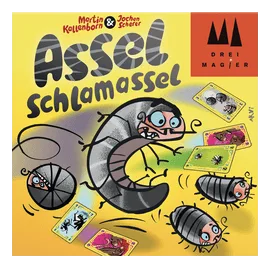
Assel Schlamassel box art

Assel Schlamassel

Players

3-6

Time

?-?

Age

8+

Weight

1.14

Rating

5.51

Fit

Teach 2.4

Teaching signal

Replay 4.1

High replayability

Interaction 3.7

Highly interactive

Scaling 4.4

Scales well

Strategy 4.7

Deep strategy

Control 3.5

More strategic control

Table feel

Assel Schlamassel has a high level of direct confrontation and strategic depth in confrontation. Players need to frequently pay attention to and react to each other's strategies and turns. However, there is a lower emphasis on cooperation in the game.

Replay value

Assel Schlamassel has a high replayability score due to its high variability gameboard, impactful expansions, deep strategic possibilities, and good scalability. The game offers fresh experiences each time it is played, provides room for players to improve their strategy, and adapts well to different player counts without compromising its appeal or balance. It is moderately easy to learn, allowing players to delve into its depth while still providing a challenge.

Luck profile

Assel Schlamassel has a moderate level of randomness impact, with random elements playing a notable but not exclusive role in determining the game outcome. However, players have substantial ability to mitigate the effects of luck through strategic decisions and planning. The game relies on a balanced mix of luck and strategy, with player decisions and strategy primarily determining the game outcome. Overall, Assel Schlamassel has a final luck score of 7, indicating a game where luck and strategy are both important factors.

Overview

In Assel Schlamassel, a.k.a. "Woodlouse Chaos", players need to know their bugs as well as how many bugs are bugging them! Each player starts with three cards in their scoring pile. Each card is one of four types of gross animal, with 1-5 of these animals on each card. One sequencing card for each animal is laid in a row. A deck with 15-18 cards is placed in the center of the table, and players take turns drawing a card and trying to communicate to the other players which animal and how many of this animal are on the card. To do this, they clap their hands one time for each animal, and they slap the table a number of times equal to the animal's place in the sequencing row — but they don't want to do this too clearly because for each incorrect guess by an opponent, that opponent must give the clue-giver a card from his scoring pile. Whoever guesses correctly claims the card, and whoever has the most cards in scoring pile once the deck runs out wins.
Media

No media imported yet.

Editions

Edition Year Language Publisher / Region
No editions imported yet.

Files

No files imported yet.

Commerce

No commerce mappings imported yet.

Credits

Designers

2
Martin Kallenborn Jochen Scherer

Artists

1
Rolf Vogt

Publishers

4
Devir Drei Magier Spiele Nordic Games GmbH Swan Panasia Co., Ltd.

Linked items

No linked items imported yet.