Table feel
Arrogance has a high level of direct confrontation and strategic depth in confrontation. Players need to frequently pay attention to and react to others' strategies and turns. However, there is limited emphasis on cooperation in the game.
Players
4-8
Time
?-?
Age
?+
Weight
1
Rating
5.83
Teaching signal
High replayability
Highly interactive
Scales well
Deep strategy
Luck-sensitive
Arrogance has a high level of direct confrontation and strategic depth in confrontation. Players need to frequently pay attention to and react to others' strategies and turns. However, there is limited emphasis on cooperation in the game.
Arrogance has a high variability gameboard, offering different experiences each time it is played. The presence of expansions adds new content and gameplay elements, enhancing replay value. The game provides deep strategic possibilities and room for players to improve their strategy over time. The player interaction score is average. It scales well with different numbers of players without compromising its appeal or balance. The game is moderately easy to learn, striking a balance between depth and accessibility. Overall, Arrogance offers a solid replayability experience with a score of 7.9.
Arrogance has a moderate influence of luck. Random elements have a notable but not exclusive impact on the game outcome. Players have substantial ability to mitigate randomness through strategic decisions and planning. The game outcome is primarily determined by player strategy and decisions, with luck playing a minor role.
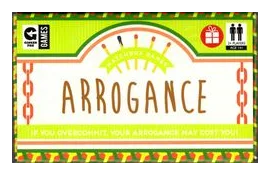
From the box: 'How many countries in the European Union can you name? The problem here is that only one person in the group knows the topic, so how arrogant will you be in your prediction, and will someone challenge you?' Players take it in turns to secretly draw a category card from the stack. They then bid how many things in that category - whether it's 'vegetables' or 'film stars' - they can name. Bidding continues around the table, with the other players unaware of what they are actually bidding to name, until one player decides not to bid, and challenges the preceding player. The category is then revealed to all players, and the challenged person must name at least as many things as they bid. If they succeed they keep the card; otherwise the challenging player claims the card, gaining a point.

No media imported yet.
| Edition | Year | Language | Publisher / Region |
|---|---|---|---|
| No editions imported yet. | |||
No files imported yet.
No commerce mappings imported yet.
No linked items imported yet.