Overview
At a glance
Is this game right for my group?
ABG editorial scores on a 1–5 scale.
Harder to teach
High replayability
Highly interactive
Scales well
Deep strategy
How it plays
How does it play?
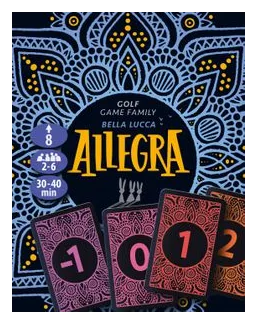
In Allegra, based on the public card game "Golf", you want to keep your score as low as possible, but to do this sometimes you must help your neighbors along the way.
Core mechanisms
Key systems that shape the decisions players make.
Auction/Bidding
Bid against other players to determine who receives an item, action, or priority.
Deck Construction
Build a deck before play by selecting cards under defined construction rules.
Pattern Building
Place elements to create arrangements that satisfy scoring or action patterns.
Semi-Cooperative Game
Players share some objectives while retaining individual victory conditions.
Highest-Lowest Scoring
Final scoring depends on balancing categories because the highest or lowest value matters.
Read the full game description
In Allegra, based on the public card game "Golf", you want to keep your score as low as possible, but to do this sometimes you must help your neighbors along the way. The deck consists of cards numbered -1 to 11, and in each of the three rounds, each player starts with twelve cards face down in a grid of four columns and three rows. Your rightmost column is also considered to belong to your right-hand neighbor, and likewise your area includes the rightmost column of your left-hand neighbor. Each player reveals any two cards in their area, then the round begins. On a turn, you either draw the top card of the deck and reveal it, or draw the top card of the discard pile. If you draw from the discard pile, swap that card with any card in your area, then discard the replaced card. If you draw from the deck, you can discard that card (turning any card in your area face up) or you can swap that card with any card in your area. If you draw from the deck, any other player can knock on the table to indicate that they want this card. You can ignore the knock, or you can give them the card; in the latter case, they then replace one card in their area with this new card, taking the old card in their hand. You then take any one card in their area and swap it for a card in your area, discarding the replaced card. The other player then places the card in their hand into the hole you created when you took one of their cards. Any time you have three identical cards in a row or column — even a row that includes a card in your left neighbor's rightmost column! — you discard those cards from play. Whenever one player has all their cards face up, each other player takes one more turn, then players sum the value of the cards in their area (which includes any cards remaining their neighbor's rightmost column). If the player who triggered the end of the round doesn't have the lowest sum, their sum is doubled. The player with the lowest total score after three rounds wins.