Overview
At a glance
Is this game right for my group?
ABG editorial scores on a 1–5 scale.
Harder to teach
High replayability
Highly interactive
Scales well
Deep strategy
How it plays
How does it play?
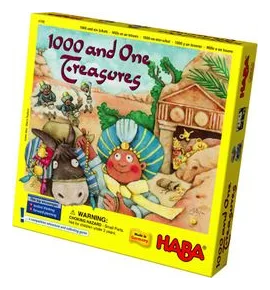
1000 and One Treasures does not, alas, contain that many treasures, but players – in the role of Ali Baba and his friends – will still be eager to grab what they can and get out of the cave before the thieves return to their hideout and catch them in the act.
Core mechanisms
Key systems that shape the decisions players make.
Read the full game description
1000 and One Treasures does not, alas, contain that many treasures, but players – in the role of Ali Baba and his friends – will still be eager to grab what they can and get out of the cave before the thieves return to their hideout and catch them in the act. To set up the game, shuffle the 19 cave entrance tiles, then lay them out at random face-up on the game board, which features a 4x5 grid with the cave entrance itself in one corner. Players take turns placing their figures on a tile, one token per tile, then the game begins. On a turn, the active player moves a number of spaces equal to the number of treasures on the tile where he's currently located, then he claims the tile on which he was standing; he replaces this tile with one from the deck, orientating the tile as he desires. (Orientation matters as some tiles feature walls, which block a player's movement. If a player cannot move the required number of spaces on his turn, he picks up his token and places it on any space he wishes.) Whenever a newly placed tile shows a bandit on it, the bandit figure moves one space closer to the cave entrance. A player can move to the cave entrance and exit the cave, keeping all treasures that he's collected – but if the bandit figure reaches the entrance while a player is still in the cave, he loses all his treasures (and undoubtedly his head). The player who escapes the cave with the most treasures wins.