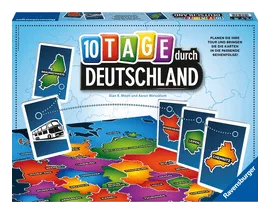
Overview
At a glance
Is this game right for my group?
ABG editorial scores on a 1–5 scale.
Harder to teach
High replayability
Low interaction
Scales well
Deep strategy
How it plays
How does it play?
10 Tage durch Deutschland – the latest title in Moon and Weissblum's 10 Days in... series – has players trying to complete a ten-day "journey" through Germany.
Core mechanisms
Key systems that shape the decisions players make.
Read the full game description
10 Tage durch Deutschland – the latest title in Moon and Weissblum's 10 Days in... series – has players trying to complete a ten-day "journey" through Germany. The first player to do so wins. Each player has a rack that holds ten tiles; each tile shows a section of Germany (with the sections having five different colors) or a train (with trains coming in the same five colors as well as white). To start the game, players shuffle all the tiles face down, then draw tiles one at a time, placing each tile in a specific place on their rack. On a turn, a player either draws a tile from the deck or from one of the three face-up stacks of tiles. The player can then either discard this tile or replace one tile on his rack with this new tile, discarding the old one. The goal is to create a "valid" journey in which all adjacent tiles are connected in the proper ways. More specifically, the first and last tiles on the rack must be regions, not trains. Two adjacent region tiles must be adjacent on the game board, too. A colored train can connect two regions of the same color; a bus acts as a wild region. Players continue to take turns until someone completes his journey and wins!